Curaçao
Silent SpringCuraçao was the site of the decisive 1954 field test of a screw-worm control method based on releasing sterilized insects. Separated from the mainland by at least 50 miles of sea, the island offered a contained setting in which Agriculture Department scientists could test whether repeated releases would prevent reproduction; within weeks, the screw-worm had been eradicated there. The result made Curaçao both a place in the history of biological control and the model for a far larger campaign in the United States.
Island as Experimental Setting
The trial followed years of work by Agriculture Department scientists in Texas, who had accumulated extensive knowledge of screw-worm biology. By 1954, after preliminary field trials on Florida islands, Dr. Knipling was ready to test his theory on a larger scale. By arrangement with the Dutch Government, he chose Curaçao, whose separation from the mainland helped define the experimental area and distinguish it from the much more difficult task of controlling the pest across a connected landscape.
The Release and Its Results
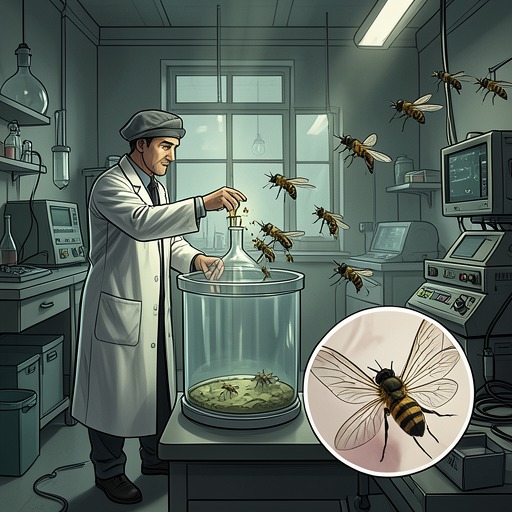
Beginning in August 1954, screw-worms reared and sterilized in an Agriculture Department laboratory in Florida were flown to Curaçao. Airplanes released them at a rate of about 400 per square mile each week. The intervention targeted reproduction rather than relying on broad chemical destruction: as sterile insects entered the population, the number of egg masses deposited on experimental goats began to fall, and the eggs’ fertility declined with it.
The change was swift. Seven weeks after releases began, every egg examined was infertile. Soon investigators could find no egg masses at all, sterile or otherwise. The book presents this sequence as evidence of eradication on the island: a measured release, a rapid failure of reproduction, and the disappearance of the observable egg masses.
From Island Trial to Larger Campaign
The success on Curaçao immediately raised hopes among Florida livestock raisers, who wanted a comparable solution to the screw-worm problem. But the contrast in scale was stark. Florida presented an area 300 times larger than the Caribbean island, making the practical difficulties enormous even after the island experiment had succeeded. In 1957, the United States Department of Agriculture moved toward a broader effort with the Florida livestock industry.
Curaçao’s significance therefore lies not simply in the outcome but in the relationship between a carefully bounded test and the ambition it encouraged. The island showed that sterile-insect releases could eliminate the screw-worm under the conditions of the trial; it did not erase the challenges of transferring that result to a vastly larger area. Its success became the proof of possibility against which the scale and complexity of the subsequent campaign could be measured.